DAMACLE DRIVES ON 2022
It's 2022 and Damacle is back on the water after being Covid-quarantined for two winters in the thankfully very comfortable and very friendly port of Combarro at the top of the Ria Pontevedra, easily reachable by air and train via either Santiago de Compestella or Vigo. But she will tarry there no longer - we're cruising to Cork, aiming to get there well in time for the delayed Cork300 regatta week of the Royal Cork Yacht Club - my porto mater!

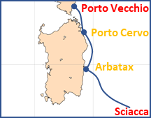
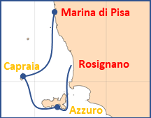
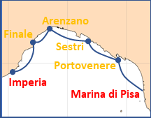
Click a chartlet to get to a particular passage.


----------------------------------------
Combarro to Ribadeo - May 2022

We've been lying here in Ribadeo for three days now, in another fine state-sponsored Galician marina, just up from the bridge across the river Eo, the boundary to the Principality of Asturias, waiting for an unusual easterly gale to abate.
It's Sunday, having left Combarro last Tuesday evening, after a great little sea trial with Ronaldo, the Combarro yard manager and Pirri, his righthand man in the yard and indeed in regattas. Our new mast (the last one got broken in a freak accident involving a truck, an anchor chain and another boat in 2019) suitably tuned up, and Damacle generally very well-prepped by Ronaldo's Ronautico team, we made good progress north straightaway beating into a F3 gusting 4 up the coast.
With all forecasts indicating that a hooley was on the way, we eschewed all the lovely Galician ports and drove on through the night past Cape Finisterre at which stage the wind began to die and we switched to engine power. The wind died but we – that's myself, son Jacques and Ria Lyden – kept going, since the easterly gale, that is still holding us back this evening, was well-forecasted and clearly coming.
Dawn the second morning, it was time to go in to Ribadeo. Easily espied from offshore because of the 30m clearing road bridge across the mouth to the Eo estuary, the approach, well-marked, was straightforward and we were docked-up by 08:30 local time.
It's a nice town and with a functioning ship newbuilding yard across the river from us, strong tidal streams, a sailing club and of course the marina, it might remind you of Cork's Monkstown Bay, but only if you wanted to be very kind to Monkstown. Another restaurant beckons up the hill (there's an elevator) tonight. Let's see what we'll try this time, so that tomorrow we will be well-fortified before finally continuing east for Bilbao, where a first crew change is planned.
Ribadeo to Getxo - June 2022

Actually, we are now already 24 hours underway out of Getxo, Bilbao's rather more grand Scheveningen, but more about that later. First I wish to relate to you the story of the car rental, the beggar and the bus trip, which should have made the paper on our stay in Ribadeo.
Ribadeo, as already noted, was lovely, but four days is a long time to stay in any one port for any restless mariner, and it did not take long for Pete to suggest we rent a car and explore the countryside. The town itself lies about 200m above the waterside and there are various steps and stairways and indeed an elevator to get you up there. Goo'ol (Google) showed a car rental up by the bus station, where Pete had arrived from Dublin via Compestella, Coruna and Lugo, so Pete knew which steps to take and up he and I went.
Alas, we walked past where Goo'ol said the rental was twice, but it wasn't. We asked in a garage repair shop, we asked in a café, but no local instructions got us further. Ria later also asked in the tourist office, but again the instructions proved misguided. The truth (our truth, anyway, be wary of fake news) was there wasn't one. So, I said, let's get the bus. But first we went to get the groceries.
A pleasant looking swarthy young man in his thirties greeted us with a smile, an 'Hola' and a begging bowl in front of the supermarket. Pete, who has a heart of gold, gave him one biggest legal Euro coin denomination and a conversation in fluent English immediately ensued – Pete, being from Co Laois, speaks good English. Our friendly beggar was from Poland, spoke seven (!) languages and had worked locally as a tourist guide, but Covid had put paid to that employ two years ago, and there was on other work to be had in Ribadeo at all.
We tested his polyglottal claim with the few languages we knew (Dutch, German and French) and he certainly spoke those. We then went into the economics of begging and he had it well worked out; averaging €25 income a day, he could save a few euro on his daily subsistence of €6.50 for food (Lidl) and €15 for shelter (youth hostel). I said buy a ticket to Ireland from your savings; there's a serious labor shortage and up to half a million Poles to make you feel at home. He said he'd need a float of €500 to get started once there, but Pete wasn't falling for that one.
So, the bus, but where to and when? Steve Pickard in Pilot Imray's seventh edition of the South Biscay book writes of a lovely little harbor, Viavelez, 30 miles or so east of Ribadeo, where, however, Damacle would never ever have or had a hope of getting in. OK, and the bus? 08:00 and back at 16:30 would work. Alarms were set and next morning it was back up the steps again, Pete, Jacques and I, Ria opting to have a day off. About €50 bought us three two-hour roundtrips. Given that the Ribadeo berth was costing €22 a day, I thought it was expensive. Pete and Jacques didn't agree.
Off went the bus, but instead of taking the main road across the new bridge at the river mouth, we went inland for maybe 20km to a town where the old road and the train crossed the Eo – a detour, but a very pretty one – into the Principality of Asturias to double back for the coast. Asturias looks just like the imagery on the milk cartons – lush green meadowlands on a wide plain, mountains in the background.
But the plain is 200m above sea level, and when the bus dropped us on the main road nowhere in particular, it was a half hour walk down to Viavelez, which was indeed very pretty, very unaccommodating for a 40ft yacht and very quiet; one bar and it was closed, and a tourist office and it was closed too. Back up the hill though, and a little further east was La Caridad, a bigger enclave. Goo'ol promised several bars and a stop for an earlier bus back at 13:30. Another half an hour later we were seated in the shade of a marquee enjoying ham rolls and coffee.
With a lot of time to kill, Jacques said there's a beach nearby. Not that near though, because 200m down. Nevertheless off we went to find a path through the trees that took us fortunately to a cliff above the beach, which looked very stony, thus encouraging us to swerve and take us past a local football ground, from which raucous noises were emanating. A tournament was in progress. Perhaps 8 team were competing. 20 minutes each way. Memories of end-of-season hockey tournaments, worst players on the wings, exhaustion and drink. And drink we found – in the clubhouse, and an hour later on we marched to the bus stop and were back in Ribadeo by 15:00 to surprise Ria, who had eschewed crossing the high bridge for fear of being blown off.
We ascended to the town for one last feast of pulpo or pork, and next morning the wind was gone. By 07:00 we were out on a lumpy open sea, under engine and bare poles heading for Gijon, where 13 hours later we were docked and ashore and enjoying beer and more fishy things in an earthy restaurant in the oldish part of town. Franco apparently flattened Gijon during the Civil War.
Getxo, the beach resort of Bilboa, tucked in slightly east and further in from the Biskaia capital's industrial port, was our next destination, and at 180nm a further overnighter way, so we slept it out, refuelled and left at about 11:00. This time we hoisted the main; under bare poles the previous passage had been uncomfortable - a sail should steady her we felt. Using the engine as our jib to allow us pinch to about 30 degree off true, we laid 60 degrees away from the coast, but a few hours later, a shift allowed a tack on to port for an 80 degree heading along the layline.
Yes, the wind was still against us, as it had been ever since leaving Combarro. All was again uneventful, except that past Santander, somewhere in the middle of the night a swarm of trawlers, working an underwater cliff edge, where the sea floor plunges from 100m to 1500m, blocked our path. But their fleet was well lit up, to put it mildly. And then as we approached Getxo and Bilbao from the north, the wind turned into the south!
Following our usually Spanish preference, we headed for the yacht club marina, which had a well-worn air about it – a few wooden huts ashore, a steel fabricated construction covered in oysters and mussels as a breakwater and the Capitana away for the day.
But first impressions can deceive and behind a low natural stone wall we found excellent showers, a swimming pool (out-of-service) and extravagant dining facilities for socio's only. Through a tunnel on the other side of the road was the new club house of the combined Real Club Marítimo del Abra (RCMA) and Real Sporting Club (RSC) association. A fine four story re-enforced concrete structure, complete with atrium where a fully-rigged local class racing dinghy was on display.
Peter recalled that twelve year's ago there had been a more modest building, but thought the ETA had blown it up. So perhaps this is one landing in the land of the Basques where it is best not to fly that province's green-and-white crossed ikurrina as a courtesy. On the other hand, maybe the bombing was a practical way of obtaining federal funding for the new real/royal facilities – I jest.
That evening, Chris from Portstewart, and once from Botany Bay on Dublin University Trinity College campus, joined us. Chris likes a stroll, but it was the promises of fine restaurants in the old port that took us along the boulevard, and past one magnificent casa after another built in the early decades of the 20th C, many designed in the Inglis style by one Manuel María Smith, in that direction. Stunning structures.
But we never made it to the old port, succumbing to the lures of the first roadside establishment, after nearly a half an hour of perambulation. We enjoyed mussels in fiery tomato sauce and on the way back to the boat a thunderous downpour.
The next morning we found the fuel dock out of service and then were on our way to La Rochelle and beyond.
Getxo to Lorient - June 2022

Six or so hours after leaving Getxo direction La Rochelle, Damacle got her first taste in 2022 of some favourable winds, and with main and jib slightly eased in maybe 14kn of breeze, we footed along nicely at 7kn + for several hours. By midnight the fun was over and instead dark clouds, illuminated almost continuously by sheet lightning, moved out rapidly from the Gascoyne coast to soak and scare us for several hours, Ria ‘manfully’ taking the worst of it on her watch. By morning the excitement was over and, motor-sailing on efficiently, 24 hours later we were making landfall.
Susan by telephone reminded us how now 17! years ago, competing in the French Flying Fifteen Nationals, Morgan Sheehy and I and the rest of the Franco-Irish fleet had to wait for the tide to rise before setting out for the race course through the narrow channel connecting the gargantuan Port des Minimes to (slightly) deeper waters. A J-122 draws more – perhaps a metre – than a F15, so we decided to seek an anchorage off the eastern shore of Ile d’Aix. Well-sheltered from all directions apart from the north west where the wind was coming from, it was a comfortable night, and next morning, after the windlass having struggled a bit with the increased friction (mu) of the newly galvanized anchor chain, we motored on for the legendary Sables d’Olonne.
Off Ile de Re, approaching Olonne, we called the main Port Ollona marina, who said they had no room because there was a race on. However, they recommended we try the Quai Garnier, which we did and they said yes but when we said we’d be in by about five thirty they said no that is plus tard, the port will be closed at 17:00 because of the IMOCAs. So we turned the Volvo up and doing 7.5kn just made it in, whilst greatly anticipating spectating the start of an IMOCA race i.e. of grand fou Fenchmen in their semi-foiling single-handed 60ft ocean greyhounds setting off for one or other very long distance race.
The Quai Garnier was brilliant and at under €30 great value, offering direct access to the centre of the popular beach resort that is Olonne. We explored and quickly got to the boulevard from where we could indeed see six or seven IMOCAs sailing up and down outside, but with no sign of them starting. Turned out it was only the parade ahead of the start of the Vendee Arctique in a week’s time, which is going to be a short one for these boats, since for Arctique read Iceland which is barely 20 degrees or 1200nm north of the Vendee region.
After some good moules marinieres on the quayside, it was off to bed for an early night and the next day it was off to Pornichet on the Baie de La Baule. As we passed Ile de Yeu in the distance perhaps we could see the beaches of Notre Dames des Monts, where now nearly 50 years ago my brother Henk and I launched our first self-built Fireball into the surf every day for a week competing in the French Nationals; our first overseas event ever. It was windy and we did well, with only three French boats out of a fleet of 60 ahead of us, plus two foreign boats, of which one, an Australian, went on to finish 2nd in the Worlds in La Rochelle two weeks later, where we didn’t do so well. It was light there.
Back in the real world we got in late into Pornichet and the marina was disappointing, being well outside the town, which in turn consisted mainly of high rise apartment blocks, and so we were off first thing in the morning for Trinite-sur-Mer. Trinite wasn’t quite as lively as Olonne, but decent all the same, with the marina right beside the town, and the bus stop for Ria to get the bus the next day for the first stage of her journey to catch the Ryanair from Nantes to Dublin just up the road.
By now it was Monday and after seeing Ria off to the bus, Chris and I continued on to the tune of “I’ll sail this ship alone” by The Beautiful South for Lorient, where TEEM were going to look at Damacle’s faulty electronics, which they did these past two days and some improvements were realized. Of course, we also managed to find the Nazis’ former submarine docks, which are impressively enormous and today home to the La Base marina, housing much of the French super maxi trimaran fleet. It was a long walk there, and after dining in a very quiet nearly-only-one-open restaurant we took a taxi back to our own marina, Kernivel, on the other side of the water to La Base.
We’ll be here one more day to test and try the new-fangled NKE Multigraphic (and get a new loo seat and a bottle of gaz) and then Saturday we sail on for Concarneau, well motor most likely, where we will find John, who is joining us by bicycle from the UK via Roscoff!
Lorient to L'Aber Wrac'h - June 2022

It’s been an exciting few days since leaving Lorient last Saturday; however beginning with an uneventful passage to Concarneau in very calm conditions entirely under engine, arriving there at 4 p.m. almost simultaneously with John by road from Cirencester on his 6 Kg all-carbon, all-dancing, hydraulic braking, electronic gear-shifting racing bike, which came neatly apart into three pieces – front wheel, rear wheel, frame – for easy marine transport.
Bike stored, we hailed Elaine aboard Whiskey Mac on pontoon D. Marcus had said that she and her husband David would be there. Not having seen Elaine for more than forty years, when she had been one of a handful of young women bravely racing big-rig (there weren’t any other) Lasers in Ireland, I had to take a bit of a punt as to whether she was she, but she was. An hour later we were all drinking beers in the cockpit reminiscing about old times. Husband David joined us too, but by then the beer had almost all been drunk.
Elaine had some useful local knowledge for us – a tip for a restaurant doing char-grilled steak by the name of L’Ancre which we duly followed up and was very good, and a tip on great value marina berthing along the French Atlantic coast. You see, if you take an annual berth for c €3000, including lift in/out and a month on the hard, in any one port de plaisance, you pay no daily fees anywhere else as you summer cruise the coast; the only proviso being to move on after two days. Worth keeping in mind.
There are strong tidal currents in the strait off Pointe du Raz and between Ile d’Ouessant and the mainland, through which we were going to have to pass through next, and I was fortunate to have two experienced seafarers with me who knew all about them; John, who had brought the very useful Courants de Maree de la Cote Ouest de Bretagne booklet published by the Service Hydrographique et Oceanographique de la Marine with him, and Chris who had set about studying them assiduously.
By bedtime, a plan had been firmly made and thus the next day, after a great sail on the wind the whole way, we anchored in a cove about six miles east of the Pointe du Raz headland. Four or five other boats arrived all around the same time as us, so we felt confident that Sainte Evette was the right choice, although the wind was whistling a little more than what we would have liked.
Next morning, we were up early and by 09:00 we were off the Pointe du Raz to catch the start of the ebb in a light breeze out of the north east under sail. Doing 8 knots we flew past. It was now a beat to Ouessant, which we had decided we would round well out to sea. But as we approached, a collective realization developed that we could cut close inside it as the tide would just be changing, and the currents, broils and overfalls would not yet be too extreme. So we did and for the first time in my life with Damacle we did 14 knots with the current adding 6 knots to our speed over the ground and 6 knots to the windspeed which in turn took our boatspeed up to 8 knots. And it got quite bouncy for a bit.
Once clear of Ouessant, things quietened down considerably and it was back to motor sailing the rest of the way into a cold enough easterly, which kept our faces and other exposed surfaces cool as the sun dry-roasted them.
The entrance to L’Aber Wrac’h – the estuary or Mouth of Wrath or just plain Jaberwock; turn in your graves, Steinbeck and Carroll – looks daunting on the chart with lots of green shading for negative depth below Low Water Spring, and not at all like the borrowed photo. As the wind was up a bit, we approached extra cautiously and, given the 6m tidal range, it was comforting to have the capitaine come out to meet us in a dinghy and point out a berth that could take our draft. Beam-wise it was a tight fit too and for once I slotted her in faultlessly. Keep speed to make the turn, then hard reverse to stop. Done.
L’Aber Wrac’h village is quite small and sleepy, but we were fairly exhausted and liked it enough to stay a second night. There are a number of restaurants but only some were open. We found a very agreeable one the second night – L’Ecailler des Abers; good seafood of course, but in an earthy no nonsense ambience. Super sheltered, I’d go in again.
L'Aber Wrac'h to Weymouth - June 2022

After Aber Wrac’h it was time to cross La Manche, which we decided to do in two passages – an over-nighter to Guernsey and an all-dayer from thence to Weymouth. As the fuel dock at L’Aber Wrac’h was only accessible for us from mid-tide to mid-tide, we were up early enough to refuel and by 10:00 well out to sea. Note: in Concarneau at low water, the fuel dock is on dry land, so we hadn’t tried that.
We sailed for a bit and then put the engine on again. The wind, keeping its promise to always come out of the quarter of our heading, was fitful, but off Roscoff and its Ile de Batz, which it (the wind) had driven us relatively close to, it (the wind) piped up, apparently as another favourable race took hold of us, taking SOG up to and beyond 9 knots for a while, but when that petered out it was engining the rest of the way and through the night to Guernsey’s St Peter’s Port.
The approach to St Peter’s Port, like L’Aber Wrac’h, is tricky, featuring a channel between a rocky well-buoyed foreshore and The Great Bank about 0.5nm to the east off the coast. Things weren’t helped by either us or the GPS’s (plural) getting briefly confused about heading. On the other hand, perhaps the 2nd Space Operations Squadron (2SOPS) of Space Delta 8 of the United States Space Force were testing their interference options, or the Russians had briefly managed to scramble the signals. Who knows?
By 09:00 we were moored up on what we thought was the waiting dock outside the Victoria Marina, the twin to the Albert Marina, right beside it. Your third option is the Queen Elizabeth II Marina. All feature ledges to keep the water in when the tide goes out, so access and excess is only possible at certain times of the day, but not for us, we were told when we contacted the Captain, as there were no berths left for yachts drawing more than 2 metres.
So we were asked to stay put on what apparently was in fact the departing dock, much to the consternation of a blue ensign flying yachtsman. Of course, as we could not go in, we were in fact on the right dock all along, as our next move would be to depart. I didn’t explain this but instead moved to another berth in slightly deeper water, under instruction of the Captain, where we would less likely ground at low water.
Naturally, we had flown a ‘Q’ and a courtesy flag as we came in, and we were a little surprised no Border Force personnel came to inspect us. So instead we went ashore for full English breakfasts, and later, passport and papers in hand, I to the Captain’s office. The formalities there were at least as casual as they had been in France. Neither p’s nor p’s needed to be shown; I just filled out a form and paid £40 (the most so far this trip) for the night. On the way back to the boat, we saw a man in border uniform. We asked was he coming to see us; he said no, he was seeing his teams (in ribs) off, presumably to patrol the coasts. I suppose we were thereby cleared in.
That evening, it being more than three years ago that Damacle last sailed Italy, we went to an Italian restaurant for our cena – Da Nelo, Nellie’s for short. A bit OTT on the Italian waiting and accents, but reasonable enough.
We were away again the next morning, again on a favourable tide and again experiencing some anomaly between where the gps’s said we were heading and where we thought we were heading, forcing us to make a short radical course change just to be sure we stayed the right (west) side of the Roustel, as we headed north for Weymouth.
Out on the open sea, the wind was finally from abaft, and warm! To keep some speed up we held a bit east of the rhumb line to Weymouth, thus getting a good view of The Casquets way out in the sea off the west of Alderney. The wind then died away and we changed course straight for Weymouth, motoring the rest of the way.
Approaching Weymouth, I was once again glad to have two such experienced offshore sailors as Chris and John aboard. There can be little doubt I would not have thought of avoiding The Shambles bank off Portland Bill nor the race between it and the Bill. There was little to no wind, but nevertheless you could see that there where we were not the waters were woolly. Needless to say, the current was with us too.
By 20:00 it was time to hail the marina on VHF (Channel 80). As so often, there was no response and we motored on, and by 20:30 we were moored up at the fuel dock of the marina built around the 2012 Olympic venue in the south west corner of Portland Harbour, having taken care (perhaps unnecessarily) not to sail through the area marked ‘Unauthorised Navigation Prohibited’ on the chart, for naval purposes presumably.
Again, of course ‘Q’ and courtesy were flying, and, Chris, on returning from a quick reconnoitre was able to report that the office had noted our arrival and our flags. Clearly, we were now in the land of surveillance cameras. Did you know, for example, there are more than 7,000 traffic speed cameras in the UK, roughly twice as many as there are in Germany or France, and more than 700,000 CCTV cameras in London alone, that’s almost 100 times as many as in Paris.
Also, as we had already been cleared into Guernsey, our ‘Q’ flag had been unnecessary. But our courtesy should have been a Red Ensign and not the Union Jack that the chandlery in Cork had palmed off on Ria before she had come out to Combarro for the first leg to Ribadeo, now a month ago.
Angie drove down from the Cotswolds to collect John the next morning and Chris found a chandlery that sold Red Ensigns. Correctly flagged by lunchtime, we were pleased to welcome Chris’ sister, Jill, and friend Allison aboard for lunch. After lunch, Jill took us in the car to the end of Portland Bill, where the view of the race offshore and the abandoned quarries ashore was impressive.
We were barely back at the marina when the wind came up, and as we ambled back down the floating jetties to our berth, we stopped awhile to observe the Optimists and other junior craft that had been out training (we are at the National Sailing Centre here) experiencing considerable difficulty getting back in. Luckily, the numbers of support and rescue ribs helping them were ample.
Only a little later, it was our turn to worry about the wind. Damacle was being pushed up hard against the pontoon she was moored alongside and more fenders were needed. We got them in, by pushing the bow out, which cantilevered just enough of a gap midships to drop them in – one by one. In the end, nine fenders were standing soldiers in a row and together were not being compressed so much that you would think anyone of them could pop anytime.
The wind died away somewhat overnight but not enough to take Jill sailing, so Jill instead took us on another excursion, this time west along Chesil Beach instead of south onto the Bill. We stopped in Abbotsbury, once the town of the abbot and his monks until Henry VIII expropriated the town, the abbey, the church, the chapple and the swannery and gave them to Lord Ilchester for services rendered, so Jill told us. Ilchester’s descendants still own the lot and the well maintained street houses and cottages are all long-term tenanted out. The views from the hill atop which the 13th C chapple was built, back to Portland along the longest uninterrupted crescent beach of the entire British coastline, were spectacular, and Sunday lunch in the Ilchester Arms was very good too.
By the time we got back to the marina, the wind had regained quite a bit of its strength and rain had been added to the local climatic experience. By now Andre had arrived at Stansted from Denmark and was on his way to Weymouth enjoying the complexities of UK public transport. At 21:00 he was on board and tomorrow we head for Torquay. The wind is forecast to moderate somewhat, and hopefully it won’t rain, but it should be a swift passage as for the first time the wind will be abeam and with it off the land for flat(tish) seas. Whoosh!
Weymouth to Plymouth - June 2022

Turned out it was a long next day to Torquay, well Brixham on the opposite Torbay shore as it turned out, where we got in just after 8 o’clock in the evening, having taken 11 hours to cover the 50-odd nautical miles across the inhospitable Lyme Bay. You see, there was still plenty of breeze as we set out from Weymouth and the 3.5kn current round the Bill was against us, so a passage close in to the headland to avoid the Race was inadvisable.
Instead then we kept outside the Race and inside the Shambles (which Dermot says are called so because they are mess, but I wondered is a right mess not so-called after them, to then be corrected on a matter of fact, to wit that in medieaval times the shambles was that part of the market where animals were slaughtered and meat sold - a right mess back then, then!). Still experiencing more confused water and more counter current then we would have liked, it was past 11:00 before we could finally turn west in the direction of Torbay, as the wind started to die away. After a while, it was back to motoring. So much for whoosh!
Brixham was quaint and very quiet. The showers, as was the case in Plymouth (but you’d expect that there, designed as they were for Olympic athletes), were excellent; the visitors pontoon less so, and for £40 a night, a regular hose-down of the heavily polka-dotted seagull shit would be a reasonable expectation.
However, Brixham has a lovely promenade along the water front, which takes you straight into the high street where alas all restaurants were closed (already and/or until further notice). We found a kebab-man opposite the Tesco and a cash machine, who, cleverly was using his situation to run a cash-only business. Good kebabs though.
The next morning, the weather had finally turned in our favour but the wind was light and so we part drifted, part motored the less than 20nm to Dartmouth. The entrance to Dartmouth is simply stunning. We anchored off past the yacht club opposite the marinas in the east bank of the river, and for the first time since Elba in 2018 we blew up the dinghy, to go ashore and investigate the old town on the west bank, propelled by our new electric outboard.
Andre did the ferrying, first putting Chris ashore and then me, and after we had enjoyed an early exceptionally fine (tasting?!) dining opportunity in Andria’s on Lower Street, he ferried us back again. What a life.
Glorious sunny summer weather greeted us again the next morning, and with the breeze up a bit, and the dinghy trussed up behind on the transom, we flew to our next destination, Salcombe, again only 20nm or so away, getting in there even earlier in the afternoon than into Dartmouth.
This time we picked up a mooring buoy, as suggested by the harbour assistant having fun in his launch. We paid him the same amount of dosh as we had to pay in Dartmouth for anchoring – about £20. Salcombe is an equally lovely spot, not quite as up-market as Dartmouth, but certainly veery touristy and with a series of sandy beaches along its river’s eastern banks, clearly ideal for family vacations.
Ashore, far away from the sea, we found a chandlery and an icecream parlour nearby. We bought a padlock for the outboard, some eyelets for the jacklines (to be fitted later) that keep the mainsail on the boom when we lower it), and a bottle of BioBlue. Chris has a more sensitive nose than I, and immeasurably more cruising experience as well, so he had been quick to notice that there was too strong an odour from the heads, which he deduced had to be coming from the holding tank, even though it was empty. Since Salcombe, BioBlue is being religiously flushed into the holding tank via the bowl, and yes, I have to admit, it makes a difference.
We also had an icecream – 2 balls each, and then we went back to the boat where Andre cooked up a fine spaghetti bol-plus.
The next day brought more good weather for Andre’s last day on board and off we set for Plymouth, where, due to a train strike, due to the soaring cost of living, due to the new Cold War, his return rail fare to London Victoria was going to be no good to him. But not to worry, there is always National Express.
So after a great sail of this time just slightly more than 20nm, a very brief historic tour of the Plymouth quayside featuring mementoes to the Pilgrim Fathers, the Tolpuddle Martyrs, Francis Drake et al, and simple sea fare in the harbour district across from the Queen’s Anne Battery Marina by walkway across the dock gates, we said goodbye again to Andre, whose bus was leaving at 23:00.
By the time Andre was on his way, Chris and I were well asleep as the weather was changing again and we were going to have to get going early in the morrow for Falmouth, to avoid the worst of what was looking like a windy forecast.
Plymouth, apart from the history, was, by the way disappointing. I’d chartered from the Queen Anne’s Battery marina with Susan, Jacques and Sandra twenty years ago, and clearly maintenance had been to a tight budget since then, despite which it was my most expensive night so far at £50 and no shore power. And although we had a good meal, the streetscape generally was a bit rundown as well. A bit like Lorient – a big maritime city that had seen better times.
Plymouth to Cork - June 2022

Two and a half hectic weeks and a weekend of recuperation have passed since Damacle safely reached Crosshaven, home of the Royal Cork Yacht Club just inside the mouth of Cork Harbour on Thursday evening late, June 30. Hectic because we had entered Damacle for Cork Week 300. Cork Week is a biennial regatta and the 300 would have been held in 2020 to celebrate the 300th anniversary of the foundation of a yacht club in Cork, which the current club claims makes it the oldest in the world. COVID of course put a stop to those celebrations but equally to Damacle’s progress north that year, so that was all alright then.
Regatta’s require you to race, so Damacle needed to be converted from cruising mode to racing mode. On the face of it, as said before, this is an easy matter of removing the curtains from her windows and port holes. But actually there is more to it than that. Off came the cushions, the bedding, the provisions, most of the tableware, the anchor, the chain, the spare anchors and chain, the liferaft, the grab bags, the dinghy, the paddles, the outboard, the hydro generator, the spare diesel, the cruising sails, many lengths of spare lines and ropes, and several boxes of paints, oils, other fluids and pastes, and other stuff. Damacle rose by three inches on the waterline, equating to more than a tonne of reduced displacement, Hagen calculated.
Lighter is faster, but so is cleaner, so Ria got me Brian Ring to dive and clean the hull, which after six weeks of Atlantic waters had got quite dirty, especially on the (old) waterline, which of course once raised had quickly dried out, so required considerable scrubbing. Brian also fitted an anode, which he found to be missing, to the Saildrive shaft. Big, big oops! Also he retrieved a batten which we had dropped in the water while mixing, cutting and matching battens for the racing mainsail and all three racing headsails, from a motley onboard selection and a further selection of spare battens Ria had collected over the years. Thank you, Brian! Thank you, Ria!
And then we went racing, Susan and I and Ria and Ria’s crew, who unfortunately for them could not race their own boat due to a problem with the mast, and our guests from Dublin, Wexford and Currabinny. For the first time during our ownership of Damacle, gennakers were flown in anger and we competed in the Coastal Fleet, learning, learning, as we raced.
But let me return to Weymouth. As planned, the morning of June 24 after Andre had left by National Express (the trains were on strike – some Irishman named Lynch the press suggested was to blame – it cost Andre his return fare to London Victoria – but I blame Putin, COVID and Sunak, in that order) for Aarhus, Chris and I left at dawn (05:30) for Falmouth.
We double-reefed the main and kept the jib quarter furled and soon enough per forecast the wind started to pick up. Seven hours later most of the 40-odd miles were behind us as the wind piped up further on our approach into Falmouth, which was already full of yachts sheltering. We ‘trotted’ up alongside a very well-kept pre-bankruptcy Nauticat 37, and soon an old First 32 or similar ‘trotted’ up alongside us.
And there we stayed for three days, Dave from Mullion (and sailonline.org) joining us for lunch midway, and Hagen joining us from Cork via Manchester and Newquay by air, and then by bus from Newquay – only 12 hours of journeying – on the third day. Falmouth is a peculiar mix of mass tourism and local descendants of fishermen, some still fishing and others doing other things including catering to tourists and not very much. At the weekend the place is heaving. All sorts of cuisine are on offer, but twice we did Tex Mex, out of place but very good. The Thai take-away was less than average though.
By Monday, the north westerly gales had abated, but the respite was only going to be brief, although long enough to make a dash for Newlyn on the opposite western shore to St Michael’s Mount on Mount’s Bay, with Penzance in the middle. I’d had a vague idea to visit Granville and my friend Guy Lapie there when we were in Brittany, but never got round to it. So now instead of gazing at Granville’s Mont St Michelle, we had the slightly less je-ne-sais-quoi St Michael’s as a focal point when we got in.
As soon as we were (in) though, it started to breeze up again, and again we delayed sailing on, this time for a mere day. All three of us liked Newlyn. It took us back to how things were back in the 60s and the 70s – a working fishing harbour with some berths for pleasure boats, but with one important innovation, a proper marina, but primarily for the fishing fleet. Disconcertingly though, a sign in the public conveniences asked sitters not to dispose of needles in the loo. The said facilities are maintained by The Fishermen’s Mission next door, but still: win some – marina; loose some – narcotics.
Newlyn of course is also the new home of the Penzance lifeboat previously based at Mousehole’s Penlee Point and whose entire crew lost their lives in 1981 attempting to rescue the coaster the Union Star that had experienced engine trouble in a Force 12 on her maiden voyage. Needless to say, the incumbents of the Union Star all lost their lives as well. We venture out onto the sea for pleasure, but never forget it is a hostile environment and those who make their living there live dangerously.
Ignoring that sobering thought, by Wednesday the forecasts, which had been remarkably accurate for the entire trip up from Spain, were showing that the wind would ease to Force 5 or so for maybe 36 hours. Still out of the north west and with a week of ocean swells built up, it wouldn’t be an easy passage to Cork, but the window was there and we took it, departing Newlyn at 13:30, with one reef in the main.
Chris, who by now I had begun to entirely rely on, timed it well to avoid the worst of yet another tidal race, now off Land’s End, and as darkness fell we found ourselves midway across the shipping channel, requiring us at one stage to go considerably off course to avoid a ro-ro. The swell was big but the wind manageable. Midway across precisely per forecast a header allowed us to tack onto starboard south of west, and after three or so hours we tacked back now onto a lift heading initially for Dunmore East, which as the day progressed became Dungarvan, then Youghal and finally Cork.
On Cork Harbour I maybe grew up, but an approach from sea was new to me, and as the wind began to whistle once again we found it hard to recognize where exactly the entrance was. The best landmark in hindsight is perhaps a copse of lonely trees high above Myrtleville on the western shore of the harbour mouth. What there also was was a gigantic tall-masted vessel with what looked like sails or spinnakers bellowing off it. It won’t be there the next time though. It was the working vessel(s) busily dismantling the Kinsale Gas platform, superstructure and jacket. Nothing is to be left behind. Can’t imagine that was discounted in the original Net Present Value calculations.